



Removing chewing gum
On this page:

Removing chewing gum
Chewing gum is one of those stains that doesn’t really look like a stain, but causes immediate problems. It sticks, attracts dirt and can become embedded in fibres or in the structure of a floor. Think of chewing gum under shoes that ends up on the carpet, a sticky patch on the sofa, or a piece that gets trampled on the floor. The longer it stays in place, the harder it sticks and the more dirt it picks up.
Acting quickly helps, but above all: choose the right approach. If you start rubbing or scrubbing straight away, you will spread the chewing gum and push it deeper into the material.
The same advice applies to these stains: Chewing gum, Chewing gum
Characteristics (anatomy) of a chewing gum stain
Chewing gum consists of an elastic gum base with sugars or sweeteners, flavourings and sometimes colourings. It is sticky in warm conditions and becomes harder in cold conditions. This means that it is usually best to remove it by first making it firm, so that it comes off without smearing. Chewing gum sticks to the fibres of carpets and upholstery, making it appear as if it is “stuck in”. On hard floors, it often remains as a sticky lump on the top layer and absorbs dirt, turning it black or grey. If you try to remove chewing gum with water, you will achieve little and often only make it more spreadable.
Chewing gum stains in carpets and rugs
Chewing gum is difficult to remove from carpet because it sticks to the fibres and immediately attracts fluff. It quickly becomes a lump that attracts dirt, making the area look dark and untidy. With deep-pile carpets, chewing gum can sink deeper into the pile and stick to multiple layers of fibres.
If it remains in place, heat will cause it to become softer and stickier, making it easier to spread. Walking can flatten the lump, resulting in a larger sticky area. Afterwards, a dark mark often remains visible due to dirt that has remained in the gum.
Please note that pulling on chewing gum can damage fibres, leaving you with a bald or fluffy spot. Rubbing can also exacerbate the problem by pushing the gum deeper into the fibres. Chewing gum is particularly treacherous because it not only sticks, but also traps dirt and thus “discolours” the area.
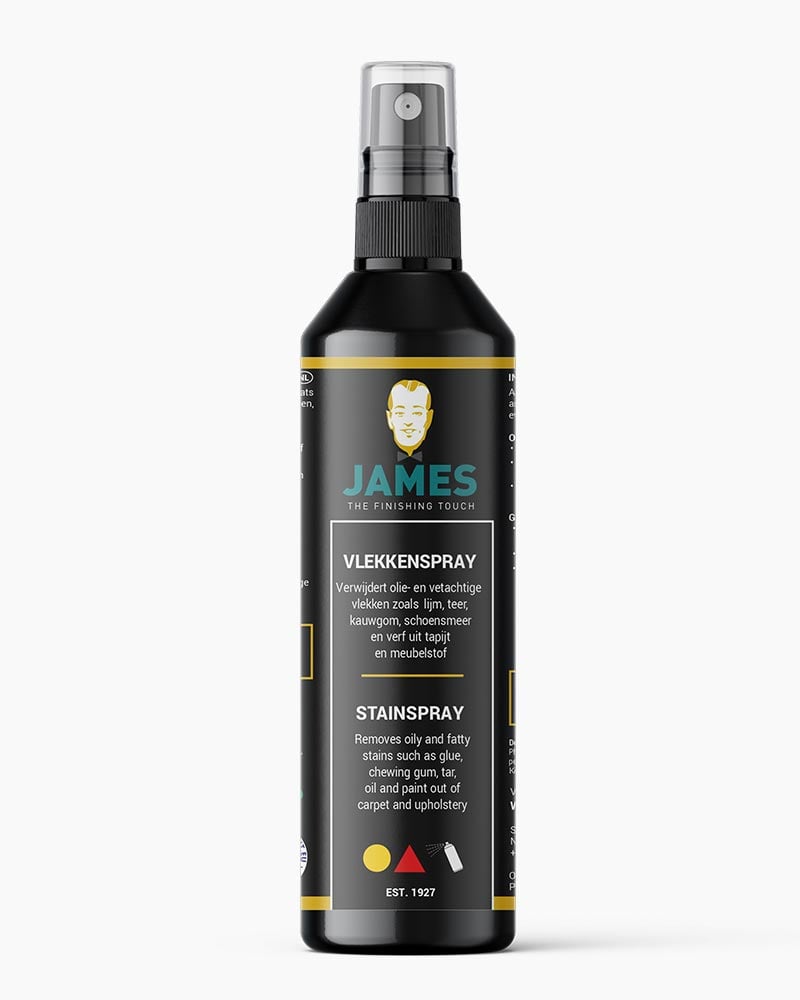
Treat directly with James Stainspray
This stain can be treated directly with James Stainspray.
- First test for colour and material resistance in an inconspicuous place: apply, let dry and evaluate.
- Spray James Stainspray on and, as far as possible, under the stain.
- Leave on for 5 minutes.
- Scrape away the loosened dirt with a spoon.
- Spray James Stainspray on a dry white cotton cloth and rub out the remains of the stain with large, gentle strokes.
- Repeat treatment if necessary.
Treat directly with James Stainspray
This stain can be treated directly with James Stainspray.
- First test for colour and material resistance in an inconspicuous place: apply, let dry and evaluate.
- Spray James Stainspray on and, as far as possible, under the stain.
- Leave on for 5 minutes.
- Scrape away the loosened dirt with a spoon.
- Spray James Stainspray on a dry white cotton cloth and rub out the remains of the stain with large, gentle strokes.
- Repeat treatment if necessary.
Chewing gum stains on hard floors
On hard floors, chewing gum remains stuck to the top layer like a lump, but walking on it often flattens it and spreads it out. This creates a sticky smear that collects dust and sand. Some may remain in the structure and seams, meaning you will continue to feel and see it.
If you leave it lying there, it will alternate between hard and soft due to temperature. This can cause it to break into pieces that you then scatter throughout the house. A dark, greyish mark may also appear because dirt continues to adhere to the sticky residue.
Please note that sand around chewing gum can have an abrasive effect and cause fine scratches when you slide it over the surface. A thin sticky layer may also remain invisible until light is shone on it. Chewing gum often involves a combination of sticking, dirt accumulation and marks.
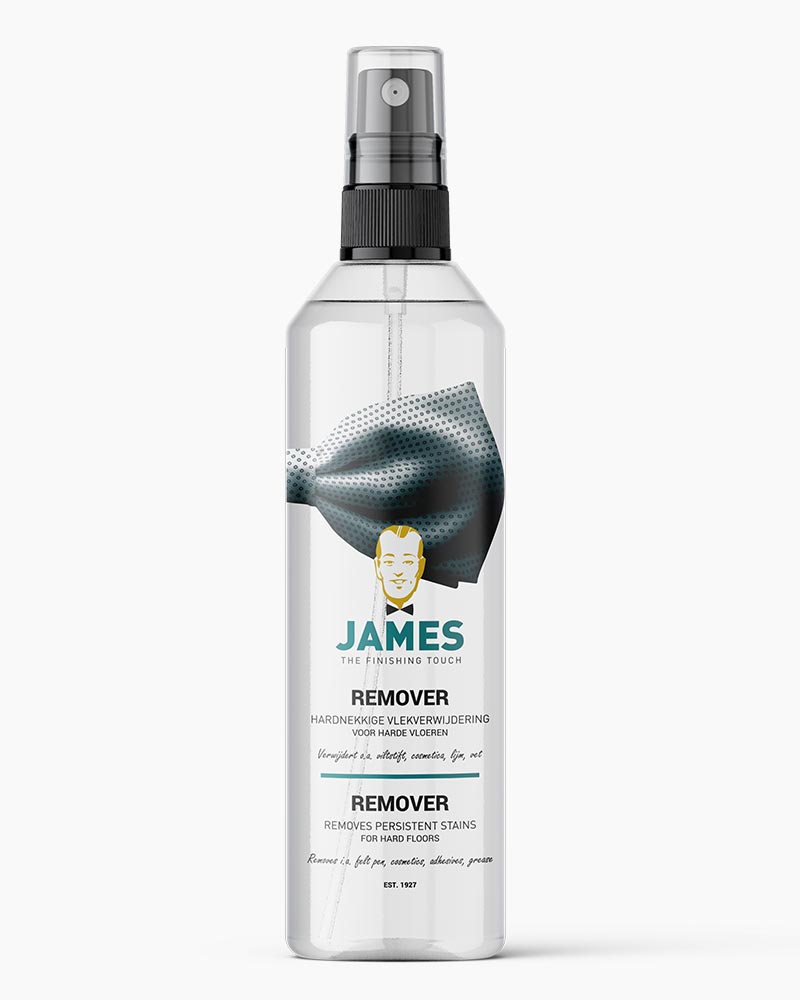
Treatment with James Remover
This stain can be treated with James Remover.
Before use, always test in an inconspicuous area for color and material resistance: apply, leave for 5 minutes, clean the tested area with water, allow to dry and evaluate.
- Spray directly onto the purpose area
- Leave to soak for about 1 to 5 minutes
- Then, use a white cotton cloth to remove the grease
- If necessary, gently treat stubborn stains with a soft brush or plastic spatula.
- After use, always clean the area with water.
Attention: be careful when working near a glue seams. Allow James Remover to soak in shortly. Do not let the product penetrate into cracks or seams.
Treatment with James Remover
This stain can be treated with James Remover.
Before use, always test in an inconspicuous area for color and material resistance: apply, leave for 5 minutes, clean the tested area with water, allow to dry and evaluate.
- Spray directly onto the purpose area
- Leave to soak for about 1 to 5 minutes
- Then, use a white cotton cloth to remove the grease
- If necessary, gently treat stubborn stains with a soft brush or plastic spatula.
- After use, always clean the area with water.
Attention: be careful when working near a glue seams. Allow James Remover to soak in shortly. Do not let the product penetrate into cracks or seams.
Chewing gum stains on upholstery
Chewing gum on upholstery sticks to fibres and attracts fluff, making the stain appear larger. Body heat makes it softer and even stickier. With fine fabrics, chewing gum can get between the fibres, meaning it is not just on the surface.
If it remains in place, the area will become increasingly dirty as dust and hairs stick to it. On seat cushions, pressure can exacerbate the problem, resulting in a wider sticky area. The fabric may also visibly change in that area because fibres stick together.
Please note that pulling too hard can damage the fibres, leaving visible damage. Too much friction can also spread the gum and make the fabric structure “smooth” or, conversely, fluffy. Chewing gum is primarily a structural and dirt problem, not just a stain.
Treat directly with James Stainspray
This stain can be treated directly with James Stainspray.
- First test for colour and material resistance in an inconspicuous place: apply, let dry and evaluate.
- Spray James Stainspray on and, as far as possible, under the stain.
- Leave on for 5 minutes.
- Scrape away the loosened dirt with a spoon.
- Spray James Stainspray on a dry white cotton cloth and rub out the remains of the stain with large, gentle strokes.
- Repeat treatment if necessary.
Treat directly with James Stainspray
This stain can be treated directly with James Stainspray.
- First test for colour and material resistance in an inconspicuous place: apply, let dry and evaluate.
- Spray James Stainspray on and, as far as possible, under the stain.
- Leave on for 5 minutes.
- Scrape away the loosened dirt with a spoon.
- Spray James Stainspray on a dry white cotton cloth and rub out the remains of the stain with large, gentle strokes.
- Repeat treatment if necessary.
Would you also like to benefit from James’ effective stain removal? Discover our full range and order your James products easily online. You’ll soon be enjoying a clean and stain-free interior again!
Frequently asked questions and myths
There are all sorts of stories circulating about how to remove these chewing gum stains. From granny’s remedies to persistent tips from the internet – but what really works? In this section, we answer frequently asked questions and debunk a few myths. This allows you to get started with confidence.
Even when the chewing gum itself is gone, a thin sticky layer often remains. You don't always notice it straight away, but you can tell because dust, hairs and sand stick to it. This causes the area to become grey within a short period of time and makes it appear as if the chewing gum is “coming back”. Such a residual layer can certainly be found in the fibres of carpets, rugs and upholstery fabric. Removing the lump is therefore often only the first step.
Not usually. Heat actually makes chewing gum softer and more spreadable. This spreads it over a larger area and leaves a sticky smear that is more difficult to remove. On carpet and upholstery fabric, press it deeper between the fibres. Hot water is therefore often a quick way to turn a small problem into a bigger one.
A sharp blade is dangerous. Hard floors can be scratched and the top layer damaged. On carpet and upholstery fabric, you pull out fibres and end up with a bald or fluffy spot. If you use something to loosen it, choose something blunt that won't cut, such as a spoon or a plastic scraper. Working calmly usually produces better results and prevents permanent damage.
Sometimes oil makes chewing gum smoother, but it is usually not a good idea. You add grease, which leaves a grease stain on the carpet or upholstery. It can form a slippery film on floors that attracts dirt. You are then exchanging one problem for two. If you are already using something to remove residue, it is preferable to choose an approach that does not leave new stains and is suitable for the surface.
Because small traces of gum remain in fibres or structure. You don't always feel them immediately, but they do attract dirt, which means you will see a dark spot later on. After removal, it helps to check carefully for stickiness and loosen any residue locally with a suitable product. Then, thoroughly cleaning and drying the area will prevent it from becoming dirty again or remaining sticky.
Deal with any stain using the right approach from James
Chewing gum is particularly annoying because it sticks and attracts dirt, but with the right approach, you can usually remove it cleanly. By first securing it firmly and then carefully removing it, you can prevent smearing and damage to fibres or the top layer. With James’ products and advice, you can safely remove chewing gum from carpets, hard floors and upholstery without scratches, marks or sticky residue. Work calmly, and it will often be resolved faster than you think.