



Removing cement
On this page:

Removing cement
Cement stains often occur during construction or renovation work: a splash when grouting, cement residue after mopping, or a blob that falls from a bucket. At first glance, it may appear to be ordinary dust, but cement is a binding agent that hardens. This can cause it to become lodged as a grey haze, grainy spot or hard lump. On floors, this often appears as a dull film, and on textiles as a stiff spot that feels rough to the touch.
It is important to act quickly. Fresh cement residue is even easier to remove than hardened cement. However, even with dried-on residues, you can often still achieve results, as long as you work gently and do not cause damage by scrubbing.
The same advice applies to these stains: Cement, Mortar, Concrete, Construction Debris, Building Material
Characteristics (anatomy) of a cement stain
Cement consists of fine mineral particles that harden into a solid mass when mixed with water. Once dry, it forms a strong, granular layer that adheres to pores, joints and fibres. Cement is also alkaline, which means that it can corrode some materials if left in place for a long time. On hard floors, it often causes a cement residue, a dull haze that is visible when light hits it. On carpet and upholstery fabric, it can remain stuck between the fibres like grit, making the fabric rough or stiff. Incorrect cleaning, such as scrubbing or sanding too hard, can cause scratches or damage fibres.
Cement stains in carpet and rugs
Carpets and rugs are particularly vulnerable to cement because cement is not only “dirty”, but also a fine powder that can penetrate deep between the fibres. When cement lands on the carpet dry, you often first see a greyish haze or light layer of dust. But as soon as moisture is added, it turns into a paste that sticks to the fibres and can harden. This results in a stiff area that feels rough and sometimes even remains in the pool as a scab. Especially with deep-pile carpets, the cement can become embedded in multiple layers of fibres, making the stain appear larger than the original spill.
What makes cement tricky is that after hardening, the material forms a thin layer of stone, as it were. This can ‘glue’ fibres together and permanently alter the structure. In addition, cement is often light in colour, which means that you will see a visible grey mark on dark carpets. On light-coloured carpets, you can see it as a dull, dusty area that no longer looks bright. If sand was also present during the manufacture of cement, this can have an abrasive effect, causing the pile to become damaged more quickly if you brush or rub too hard.
When dealing with carpets and rugs, you need to make sure that the cement does not turn into a wet mess that spreads. Once cement gets wet, it adheres much more strongly and can cover a larger area. Excessive rubbing is also risky: you push the particles deeper into the fibres and make the pile rougher or uneven. Cement therefore requires control: preventing it from spreading and preventing damage to the fibres or further embedding the stain.
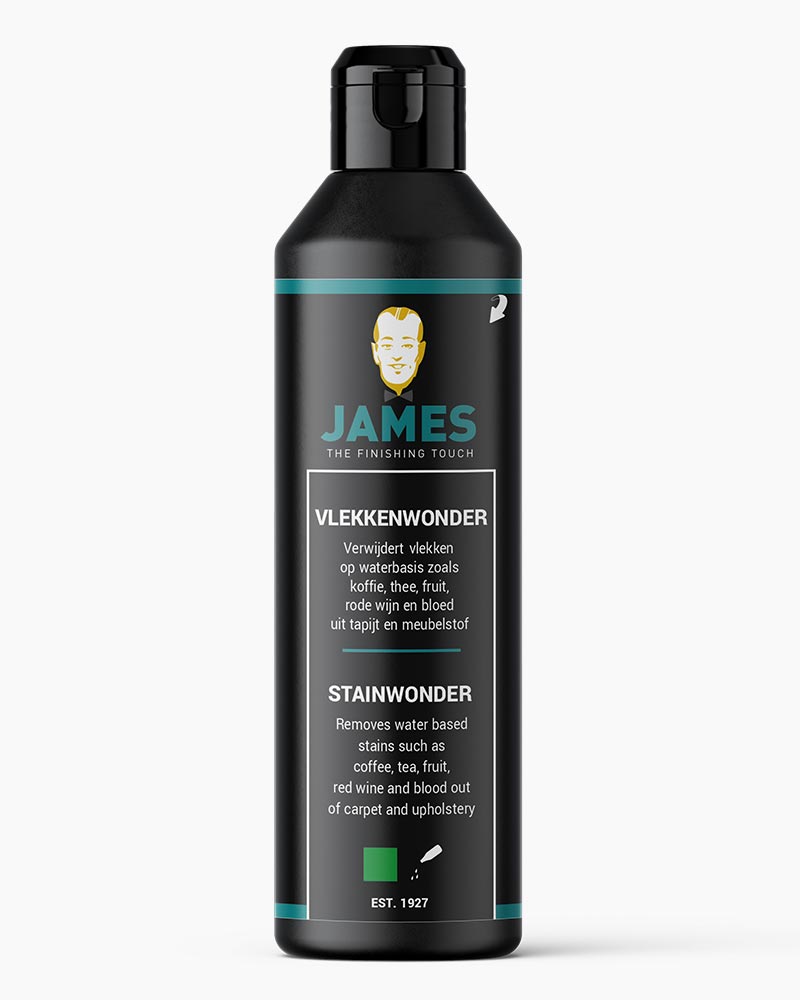
Treat with James Stainwonder
This stain can be treated with James Stainwonder. All you need is a bottle of James Stainwonder!
- Test for colour and material resistance in an inconspicuous area: apply, let it dry completely and evaluate.
- Allow the surface to dry completely.
- Apply James Stainwonder to the dry stain by turning the bottle upside down, placing the opening of the bottle on the stain and treating the entire stain.
- The product works for 12 hours, so the effect does not have to be visible immediately.*
- Is the stain not completely gone after treatment, but it has improved? You may repeat the treatment.
* With wool: in the vast majority of cases, James Stainwonder does not cause any discolouration. You have already established this by testing the product in an inconspicuous area as described above. In that case, you do not need to carry out the following step. If a (slight) discolouration did occur, you should neutralise James Stainwonder as soon as the stain has disappeared. In this case, immediately place a damp cotton cloth on the spot where the stain was and let it dry.

Immediate treatment with water
This stain can be treated immediately with water. For this you need a white, cotton cloth and water. Follow the steps below:
- First remove, as far as possible, any loose substances using a spoon.
- Immediately hold a white cotton cloth under the cold tap, wring it out and place it flat on the stain.
- Leave the cotton cloth in place to dry completely, no peeking. Should the cloth become saturated, replace it with a fresh one as described above. Then leave the cloth until it is completely dry.
Note: Do not perform the above instructions if water causes aspect loss or discoloration on the material to be treated.
Cement stains on hard floors
On hard floors such as PVC, vinyl, LVT, laminate and natural stone, cement often appears as a white haze, splashes or a grainy film on the top layer. Wet cement is more likely to leave streaks or a grey film that can harden after drying. The annoying thing is that cement tends to stick to surfaces, along edges and in small scratches, which means you can’t always remove it with a simple wipe. This haze is particularly noticeable on matt floors, as the light reflects differently and the floor looks “dull”.
Cement is particularly tricky with natural stone, as some types of stone are porous and cement residues can become lodged in the pores. In addition, cement and mortar residues can alter the appearance of the surface, causing you to see a stain that looks more like discolouration than loose dirt. There is also something to bear in mind with laminate and click flooring: cement slurry or cement water can seep into joints and dry there, leaving a permanent edge or rough joint.
What you need to bear in mind with hard floors is that sanding or aggressive scrubbing can quickly damage the top layer. Cement feels grainy, and those grains act as an abrasive when pressure is applied. This can cause scratches that remain visible even after the cement residue has been removed. The risk is therefore twofold: cement can adhere as a haze, and the approach can damage the top layer if you work too hard or too abrasively, especially with PVC, vinyl and laminate.
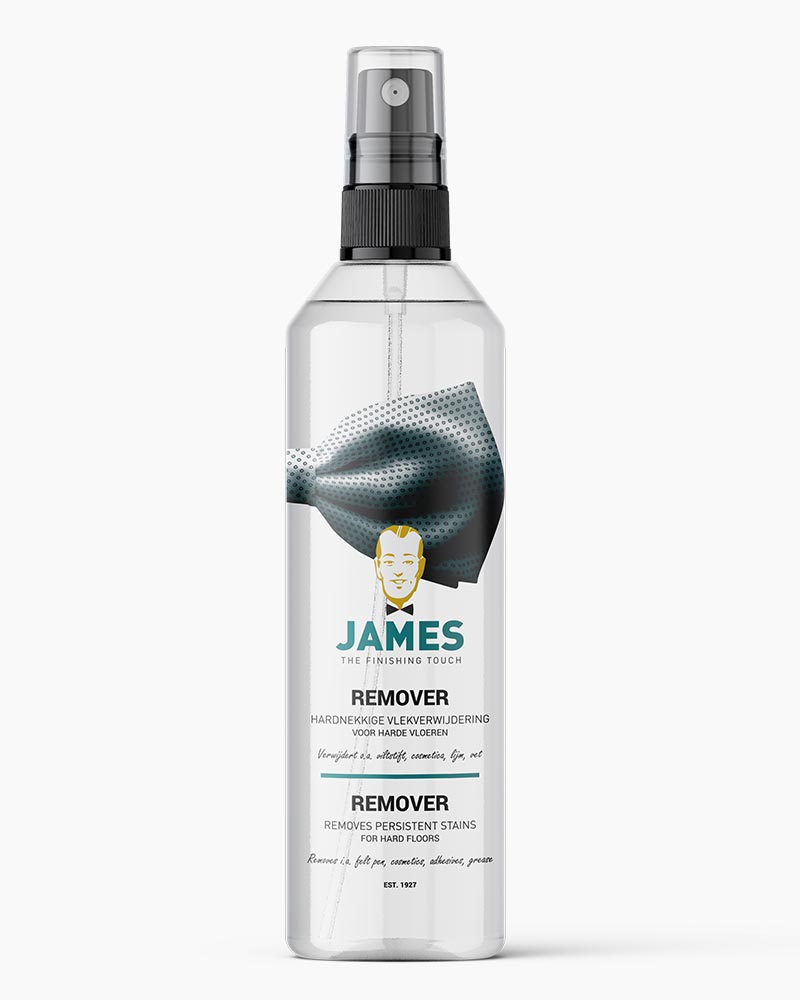
Treatment with James Remover
This stain can be treated with James Remover.
Before use, always test in an inconspicuous area for color and material resistance: apply, leave for 5 minutes, clean the tested area with water, allow to dry and evaluate.
- Spray directly onto the purpose area
- Leave to soak for about 1 to 5 minutes
- Then, use a white cotton cloth to remove the grease
- If necessary, gently treat stubborn stains with a soft brush or plastic spatula.
- After use, always clean the area with water.
Attention: be careful when working near a glue seams. Allow James Remover to soak in shortly. Do not let the product penetrate into cracks or seams.
Treat using a moist cotton cloth
This stain can be treated immediately with water. Use clean water and preferably a white, cotton cloth.
Cement stains on upholstery fabric
Cement on upholstery fabric is less common, but when it does occur, it is difficult to remove because the particles quickly become embedded in the fibres. Dry cement leaves a grey dust spot that initially appears to be “loose”. But as soon as moisture is added, it turns into a paste that sticks to the fabric and hardens after drying. This can cause the fabric to feel stiff in that area or you may feel small hard spots that do not seem to go away. On woven fabrics, you often see a slight haze between the threads, whereas with microfibre you are more likely to see a dull spot that looks different from the rest.
Over time, a cement stain can become more visible because the hard residue attracts dirt and because the fabric structure changes. Pressure, especially on seats or armrests, can cause cement particles to be pressed even further into the fabric. This not only leaves a visible stain, but also an area that feels rough or wears more quickly. On light-coloured surfaces, cement is particularly noticeable as a greyish shadow, while on dark surfaces it often appears as a dull, dusty area.
When working with upholstery fabric, it is important to ensure that the cement does not become wet in a way that causes it to spread. Rubbing hard is also risky: you push the particles deeper into the fibres and you can damage the fabric structure, leaving the stain permanently visible. Cement is a stain where the difference lies in control: preventing it from adhering and preventing mechanical force from making the fabric rough, fluffy or uneven.
Treat with James Stainwonder (*furniture fabrics)
This stain can be treated with James Stainwonder. Always test for colour fastness and material perpetuation in an inconspicuous area: apply, let it dry and evaluate.
- Allow the surface to dry completely.
- Apply James Stainwonder to the dry stain by turning the bottle upside down, placing the opening of the bottle on the stain and treating the entire stain. Spread a little James Stainwonder on a clean, dry cotton cloth towel and use it to cover the stain. This is to prevent circles from appearing after drying.
- The product works for 12 hours, so the effect does not have to be immediate. Do not remove the cotton cloth until it is dry to see the result.*
- Is the stain not completely gone after treatment, but it has improved? You may repeat the treatment.
* With wool: in the vast majority of cases James Stainwonder does not cause any discolouration. You have already established this by testing the product in an inconspicuous area as described above. In that case, you do not need to carry out the following step. If there is a (slight) discolouration, neutralise James Stainwonder with water as soon as the stain has disappeared (to do this, however, lift the cotton cloth in between to be able to assess whether the stain has already disappeared). In this case, immediately place another damp cotton cloth on the spot where the stain was and let it dry.
Immediate treatment with water
This stain can be treated immediately with water. For this you need a white, cotton cloth and water. Follow the steps below:
- First remove, as far as possible, any loose substances using a spoon.
- Immediately hold a white cotton cloth under the cold tap, wring it out and place it flat on the stain.
- Leave the cotton cloth in place to dry completely, no peeking. Should the cloth become saturated, replace it with a fresh one as described above. Then leave the cloth until it is completely dry.
Note: Do not perform the above instructions if water causes aspect loss or discoloration on the material to be treated.
Would you also like to benefit from James’ effective stain removal? Discover our full range and order your James products easily online. You’ll soon be enjoying a clean and stain-free interior again!
Frequently asked questions and myths
There are all sorts of stories going around about how to remove these cement stains. From granny’s remedies to persistent tips from the internet – but what really works? In this section, we answer frequently asked questions and debunk a few myths. This allows you to get started with confidence.
Vinegar is often mentioned because it can react with mineral residues. But it is not without risk. Vinegar can damage the surface of natural stone and cause dull spots. On some floors, it can also damage the top layer or edges. In addition, vinegar does not work well on hardened cement in fibres, because it mainly spreads it around. If you are considering using anything acidic, always test it on an inconspicuous area first. A suitable product for mineral contamination is usually safer.
Sanding seems effective, but it often damages the surface. On PVC, laminate and vinyl, the top layer may become scratched or develop differences in gloss. On natural stone, you make the surface dull, which actually makes it stand out more. Scrubbing does not work on carpet or fabric either, as it damages the fibres. It is preferable to loosen and remove cement residue. This may take a little more time, but it prevents permanent damage that cannot be repaired.
Hot water alone is usually not enough. Cement is a binding agent that reacts with water. With fresh residue, you can sometimes loosen it, but you also run the risk of activating cement dust and spreading it into a larger haze. On textiles, the cement can clump together and become more deeply embedded. Therefore, first work dry and then use a suitable agent intended for mineral contamination. This allows you to solve the problem in a targeted manner instead of making it worse.
Baking soda is not suitable. Cement is already alkaline, and baking soda is too. This does not provide an effective solution. Baking soda can also have an abrasive effect on floors, causing scratches and dull spots. It may remain in carpets and upholstery as powder residue and cause a haze. So you gain little from it and increase the likelihood of extra work. It is preferable to opt for dry removal and then use a product that specifically helps against mineral deposits.
Because cement dust or haze is often not actually removed, but only dispersed. If you mop with too much water, you will pick up fine particles and then allow them to dry on the floor again. This creates a dull glow, especially when light hits it. First, you must remove loose particles dry, then loosen and absorb the haze in a targeted manner. Afterwards, wipe the floor thoroughly and dry it. This will prevent a new film from forming.
Deal with any stain using the right approach from James
Cement stains and cement residue can be stubborn, especially if you are too late or if you start sanding. By first removing dry dirt and then cleaning specific areas, you can prevent scratches, dull spots and permanent haze. With James’ products and advice, you can safely tackle cement residue on carpets, hard floors and upholstery without damaging fibres or top layers. Handle it carefully, and you will get your surface nice and smooth and clean again.